Mobirise Website Builder

Teaching Practice

← Menu

Time-Based Arts as a Model for Transdisciplinary Learning

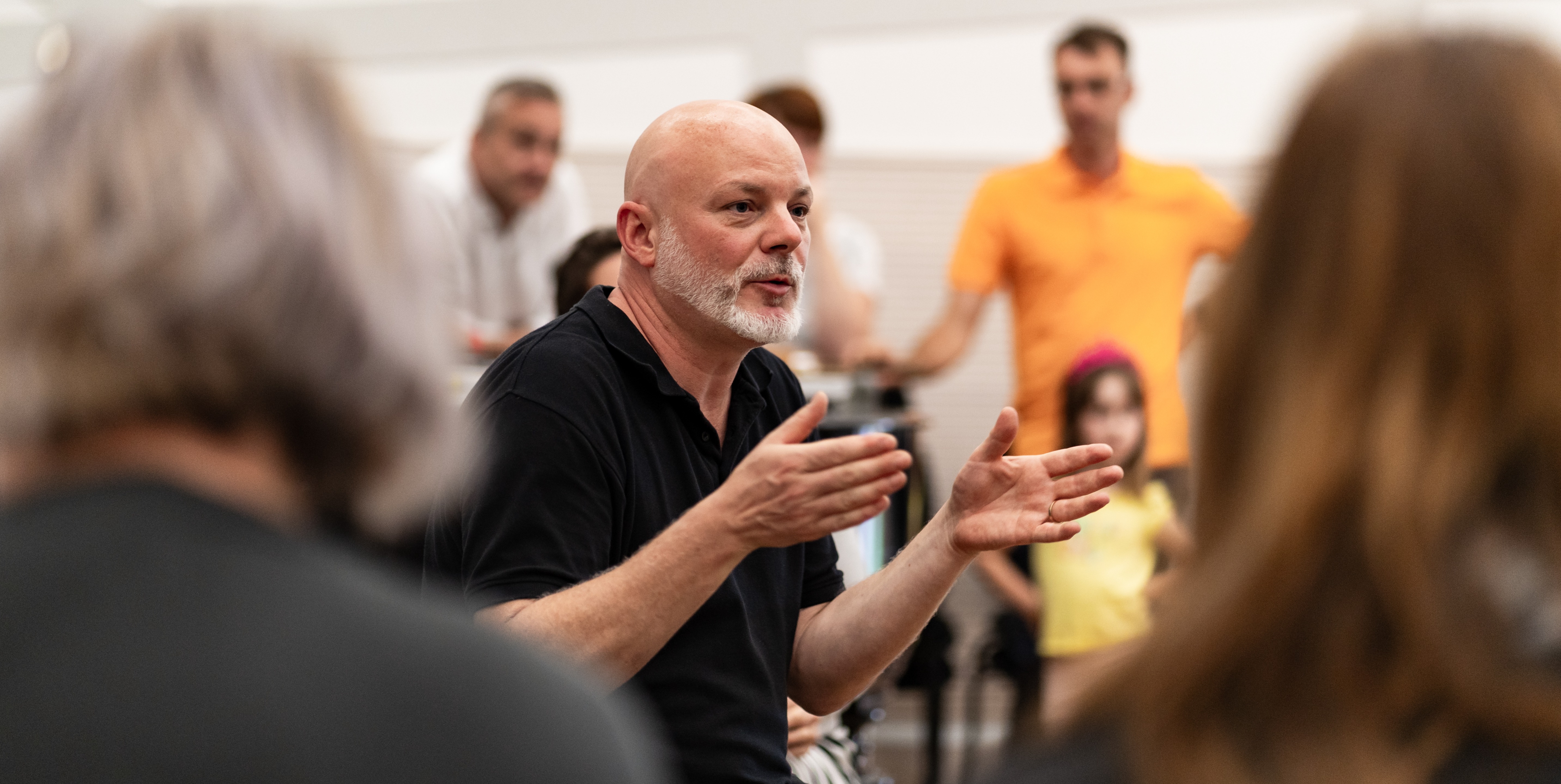
Maurice de Martin’s teaching practice evolves from a broad spectrum of time-based artistic practices—particularly music, performance, and collective working formats of process art.

Since 2010, de Martin has been a lecturer at the "Y-Institute for Transdisciplinarity" at the Bern University of the Arts, where he also teaches in the departments of theatre and research. In addition, he has taught as a guest lecturer since 2010 at numerous art academies, universities, and other educational institutions in Germany and abroad, including Folkwang University of the Arts, Alanus University of Arts and Social Sciences in Alfter near Bonn, Masaryk University Brno, the National University of Music Bucharest, the University of Nantes, the University of Klagenfurt, Burg Giebichenstein University of Art and Design Halle, Brockwood Park School in Hampshire (UK), and currently at the Brandenburg Medical School "Theodor Fontane" (since 2018).

A central focus of his research in teaching is the question of how developed modes of engaging with time, attention, rhythm, complexity, and presence are not only effective within the time-based arts, but can also be transferred transdisciplinarily to other fields as well as to contexts beyond art. His teaching formats therefore understand time not as an organizational framework, but as a malleable medium of knowledge, experience, and action.

Over many years, de Martin has developed a range of inter- and transdisciplinary teaching formats in close collaboration with the Bern University of the Arts and the Brandenburg Medical School "Theodor Fontane". Students from medicine, psychology, and therapy, as well as from virtually all artistic disciplines, work on questions of collective and individual attention, authorship and process design, timing, and the sequencing of complex actions. Learning is understood as an experiential and interactive process in which shared and individual practice and reflection are intertwined.

From the condensation of these experiences, CHRONARTA emerged. The initiative brings together artistic practice, research, and teaching into an open practice of working with time. Its expertise lies in the precise framing and design of temporal spaces in which new forms of perception, collaboration, and action can emerge.

Examples

Seminars & Workshops

3-day seminar
Studium Fundamentale
Brandenburg Medical School
2023–2026, once per summer/winter semester

In Hinduism, it is believed that all living things pulse. A good example is the heartbeat, which constantly changes in response to internal and external factors. These changes, in turn, affect our state of being and our dynamic relationship with the world around us.

The creation of such dynamic tensions is also at the core of rhythm in music. Through rhythm, we can be brought into distinct physical and emotional states. We recognize this when we hear a piece of music whose “groove” carries us along for reasons we often cannot—and do not wish to—fully explain. Goosebumps, the urge to move—there is something almost magical about it. A groove “you can’t help but move to” is an especially intense form of rhythmic play, unfolding at a specific pulse. Its intensity arises through repetition and a particular sense of timing. When we not only allow ourselves to be carried by it emotionally but also approach it analytically, we begin to understand: rhythm is mathematics, and at the same time a delicate sequencing of complex temporal processes—processes we encounter in many other fields, especially in medical teamwork contexts.

So what does it really mean to be “at the pulse of time”? Or ahead of it—or behind it? At its core, this is about the phenomenon of time: how we experience it and what we do with it, individually and collectively.

This seminar takes precisely this as its starting point: through an intensive practical weekend, students—guided by a rhythm expert, master percussionist, and university lecturer—are invited to immerse themselves in the many facets of rhythm, both in practice and in reflection.

The course is also suitable for those who are convinced that they are not, or only minimally, musical.

3-day seminar
Studium Fundamentale
Brandenburg Medical School
2019–2023, once per summer/winter semester

“In the beginning was play,” says the Dutch cultural historian Johan Huizinga.

In his classic Homo Ludens (man as player), he sketches—somewhat tongue-in-cheek—a countermodel to the anthropological idea of Homo Faber (man as maker). Homo Ludens “plays” continuously, accompanied by a sense of tension, serious joy, and the awareness of temporarily stepping outside everyday life.

Play has rules to which players voluntarily submit. The ambitious learn to stretch these rules; cheaters manipulate them—an act that, once exposed, typically leads to outrage and exclusion from the game. Within play, participants form an ad hoc community that emerges from anonymous multiplicity and, within a space set apart from reality, pursues its own activity with great seriousness—ideally evolving into a kind of organism of its own.

This seminar takes precisely this as its point of departure:
Through a selection of collectively realized play situations—based on specific ways of organizing shared action in space—it seeks to initiate scenarios that allow for the exploration and experience of group dynamics and individual agency in unusual ways, and to move beyond one’s own limits.

Forms and principles of interaction that also play a role in everyday medical practice reveal themselves here from a different perspective.

Following all the rules of the art, the seminar will experiment across disciplines—from music to theatre to performance art—testing, analyzing, and discussing different models in changing constellations, discovering new approaches while re-encountering the familiar in unexpected ways.

2-day workshop
MHB Summer School on the topic “The End of Life as Part of Life”, August 2023

In a remote region of Romania lies the village of Săpânţa. There you find the Cimitirul Vesel, the “Merry Cemetery.” Around 40 years ago, the local community adopted an unusual approach to commemorating the dead: they commissioned a local woodcarver to create wooden crosses for each newly deceased member of the village. These crosses feature colorful imagery, intricate ornamentation, and short folkloric verses that recount the lives of the deceased in a distinctly humorous—sometimes even bluntly ironic—manner.

This site is unique in Europe, yet it reflects a broader practice found in many cultures: forms of remembrance that incorporate a particular kind of humor, situated somewhere between subtle cheerfulness and tender melancholy. This raises the question of what kind of resonance such a practice of mourning creates—for the bereaved as well as for us observing from a distance.

To explore this, the first day of the workshop will be dedicated to a remote investigation of the cemetery. We will then look at other unusual practices of remembrance from different cultural contexts and discuss them together.

On the second day, the focus will shift to practical artistic work, culminating in a collective piece: we will approach the model of the “Merry Cemetery” by designing our own version of such a commemorative site for Neuruppin and installing it for one day at a selected location in the immediate vicinity of the Summer School.

The workshop is open to anyone interested in the intersection of a sensitive and respectful approach to remembrance with the possibility of a reflective, imaginative, and humor-infused artistic practice.

1-day workshop
MHB Summer School on the topic “The Beginning of Life”
August 2025

A “welcome music” for mothers and their newborns

In this workshop, participants will learn how AI-based tools can be used to create music and song lyrics that can play a role in the period shortly after birth—without requiring any prior musical training.

Working in small groups, participants will experiment with ways of producing individualized “welcome songs” for mother and child. To do so, we will engage with imagined persons and situations in the context of birth, generating the material for each composition during the workshop and ultimately bringing everything together through AI into a collection of “birth songs.” After the production phase, the works will be shared and discussed collectively.

The workshop brings together artistic, medical, and psychological practices within the highly sensitive context of childbirth. Music serves not only as a gesture of care, but also as a means of emotional reflection—and even processing—of an intense life moment for everyone involved.

Requirements: a well-functioning laptop with updated browsers and headphones to be brought to the workshop; prior experience with AI tools is helpful but not required.

Alternative Playing Attitudes in Performance and Improvisation
Y Institute, Bern University of the Arts
5-day workshop
5 editions, 2011–2016
Directed by: Maurice de Martin (composer and performer, Berlin)

“Art is a crucial, dangerous operation we perform on ourselves. Unless we take a chance, we die in art.” — Morton Feldman

This toolbox presents, through a kaleidoscope of artistic practices beyond the mainstream, ways of developing a style-independent approach to performance—through an individualized craft combined with a disciplined playfulness of thinking and a reflective willingness to take risks in action.

Prominent as well as lesser-known examples from outsider art, the margins of improvisational practice, underground folklore, Fluxus art, trash performance, as well as concepts from experimental jazz, rock, and pop up to noise art, will be explored and directly translated into tangible and audible results within the group.

Participants are thus equipped with a range of “tools” that open up alternative ways of engaging with their own abilities, enabling a free movement between disciplines.

The workshop is explicitly open not only to musicians but also to participants from all other disciplines.

Y Institute, Bern University of the Arts
5-day workshop
Spring Semester 2013
Directed by: Maurice de Martin

The course explores the relationship between art and everyday life—and seeks to investigate the possibilities of a conscious encounter between these two “realities.” At the center of our work is an artistic research process in public space, focusing on encounters between the familiar and the unfamiliar.

Over the course of five days, we will immerse ourselves in the perceived everyday space of our surroundings, searching for the hidden characteristics of specific places, living beings, and objects. Through artistic methods of observation, interpretation, and intervention, we will collectively explore how “reality” can serve as a source of inspiration for artistic work.

The course is open to all HKB disciplines. The only requirements are a willingness to engage in dialogue, curiosity, and openness to the unexpected. Sturdy footwear is also recommended.
Y Institute, Bern University of the Arts
Y Semester Project 2011
Project leads: Maurice de Martin, Dr. Corinne Rose
Guest lecture: Anton Burdakov (neuroscientist)

“Men are disturbed not by things, but by the views which they take of them.” — Epictetus

Our Little Shop of Horrors aims to create a laboratory space in which we explore specific forms of fear and our attitudes toward them—while testing them as a rich field of association for artistic creation between humor and seriousness.

Based on a theoretically grounded engagement with the subject, the space will gradually take shape over the semester—like a temporary delicatessen of fear—filled with a wide range of reflections, objects, musical pieces, performances, micro-theatre works, mash-up collages, installations, texts, and found-footage videos. Everything that sparks inspiration is welcome; free thinking and working are essential.

The goal is to create an atmosphere in which the theme of fear unfolds into an open creative process and manifests itself in forms of collective artistic expression.

The project is open to students from all disciplines—the more heterogeneous the group, the more exciting the work.

Learning objectives → becoming aware of one’s own (fear-related) limits and expanding them within the context of artistic processes.

Alanus University of Arts and Social Sciences
Studium Generale
2-day workshop
Spring Semester 2015
Directed by: Maurice de Martin

“Art is a dialectical comedy through which the difference between reality and fiction is negotiated.” — A. Danto

In his now classic work The Transfiguration of the Commonplace, the art philosopher Arthur Danto describes how contemporary artists transform entities of everyday life into something entirely unexpected through minimal interventions. This, he suggests, represents a fundamental condition of human existence: reinterpretation as a symbol of the individual’s capacity to shape both life and environment freely. Marcel Duchamp’s urinal remains the most famous example of a culture of “reality hacking,” which continues to challenge aesthetic, theoretical, and technical discourse alike. Today, this experimental practice extends even to the transformation of living and situational contexts: composing music with bioluminescent algae, working with substances of one’s own body, or “manipulating” a public referendum as an art project—raising, of course, the question of the limits of art.

The Berlin-based artist, researcher, and lecturer Maurice de Martin has developed a teaching module that enables students to immerse themselves in the world of “reality hacking,” engaging in hands-on experimentation within a workshop setting while also reflecting theoretically in a roundtable format. The course is accompanied by selected inputs from the instructor on process art, laboratory art, camouflage art, and intervention art.

Y Institute, Bern University of the Arts
5-day workshop
Spring Semester 2019
Course led by: Maurice de Martin — musician, composer, process artist (Berlin)
& Susanne Sachsse — actress, singer, and director (Berlin)

“Fuck the Facts” — John Zorn / Naked City

A lie is a deliberate reinterpretation of reality. It is truly effective only when it is more convincing than reality itself—only then is it perceived as truth. Starting from the premise that, within art as a potential counter-world to reality, everything is by definition “fake,” one might elevate the art of intelligent bluffing to a creative virtue and establish a “practice of productive lying.”

As a model for such a practice, two artists experienced in the (re)interpretation of realities have developed this toolbox. Drawing on key examples from a wide range of disciplines and practices—radio drama (Orson Welles’ War of the Worlds), appropriation art (Sherrie Levine), imaginary biography (Carol Duncan & Clifford Irving), art forgery (Wolfgang Beltracchi), musical parody (P.D.Q. Bach), media hoaxes (The Yes Men)—and enriched by their own artistic experience, participants will explore both the productive potential and the problematic aspects of artistic lying and deception. Naturally, questions of authenticity and authorship will also be put to the test, as well as the value of artistic illusion in a world shaped by fake news, alternative facts, and media spin.

Complementing the theoretical discourse, the workshop places strong emphasis on practical experimentation. Over the course of the week, participants are invited to develop—individually or in small groups—an original fake, to present it, and to open it up for discussion.

The course is open to all disciplines.

Alanus University of Arts and Social Sciences
Studium Generale
2-day workshop
Winter Semester 2016
Directed by: Maurice de Martin

Is artistic research a modern construct, or a form of knowledge practice rooted in a long tradition—driven by curious individuals who repeatedly take risky leaps across disciplines?

In this seminar, participants will have the opportunity to work with a professional artistic researcher and to conduct an experiment focusing on the United Nations.

Based on materials collected by the instructor during his residency at the UN as part of the research project UN.KNOWN SPACES, we will approach the complex realities of this global community of 193 states and explore questions concerning the potential interplay between art, science, and politics.

Through artistic research methods such as aesthetic observation, artistic interrogation, empathetic curiosity, and performative irritation, we will gain insights into the current state of “negotiating world peace” and reflect on how the tension between idea and reality feeds back into the relationship between individual and collective societal interests.

Institute, Bern University of the Arts
5-day workshop
Spring Semester 2021
Directed by: Maurice de Martin (COVID remote workshop)

“…deeply hurtful and discriminatory is the human prejudice that vampires fear the light of day!” — Count Dracula

Sigmund Freud describes “the uncanny” as the experience of something foreign within the familiar—particularly unsettling when it emerges unexpectedly, in broad daylight, out of the shadows.

This toolbox, developed by Berlin-based artist Maurice de Martin specifically for the Y Institute’s annual theme, turns day into night and embarks on a multi-day exploration through the city of Bern, always in search of hidden aspects within the shadow of its idyllic surface. Or perhaps the idyll itself is what is truly uncanny?

In the format of collective group work, we will research particular phenomena, visit specific locations, speak with people about unusual situations, and—supported by inputs from the instructor—develop a work that will be presented in public space at the end of the course.

The project is open to all HKB disciplines. Requirements for participation include a willingness to engage in dialogue, curiosity, and openness toward discomfort—and possibly sturdy shoes and rain gear.


Research Toolbox: Investigative Questioning in Music and Music Education
Y Institute, Bern University of the Arts
5-day Master’s workshop
Semester course, 2017–2023
Led by: Stephan Zirwes, Maurice de Martin, Andreas Cincera

The identification of relevant topics, research processes, the development of questions, and the field of methods and research design are approached both theoretically and interactively.

Musician, composer, and sound artist Maurice de Martin brings different fields of musical inquiry into focus through a series of transdisciplinary situations. Practical experimentation meets theory, individual reflection meets group-based analysis and discussion. Participants develop research questions relevant to their own work and practice articulating project outlines within a collaborative setting.

Double bassist, educator, and researcher Andreas Cincera approaches the question—through interactive inputs—from multiple perspectives: to what extent can the complex realities of learning and teaching music be explored, reflected upon, and partially explained through research, and what role does intuitive action play in this process?

Through the moderation of music theorist and HKB lecturer Stephan Zirwes, participants are encouraged to develop their own research questions, design potential projects and approaches for addressing them, and critically evaluate their potential within the group. The toolbox explicitly offers the opportunity to discuss and further develop concepts for upcoming MA theses.

Methodology

Methodologically, the working processes of MdM’s teaching projects usually begin with an open situation at a “round table” and a clear—yet often unusual, sometimes even slightly unsettling—initial proposition introduced by the instructor. Drawing on Vilém Flusser’s concept of “communicology” and his roundtable discourse, everything is first placed on the table: questions, interests, materials, and perspectives of all participants—without any predefined hierarchy.

Within this experimental conversation, these elements are continuously recombined until a new stage of “discursive intensification” emerges. This corresponds to what Peter Brook describes in theatre rehearsals as a “formless hunch”: an intuition that gradually condenses through collective work, sustaining the tension of the process. Step by step, questions and approaches take shape as a collective achievement of the group.

The role of facilitation is guided by principles described by Jacques Rancière in The Ignorant Schoolmaster – Five Lessons in Intellectual Emancipation, based on the teaching practice of the French educator Joseph Jacotot.

At its core lies the assumption of the equality of inherently different intelligences: learning does not primarily arise from authoritative explanation at a distance, but through attention, translation, repetition, and the learners’ own initiatives. The “ignorant schoolmaster” does not explain, but structures the process—intensifying or slowing it down when needed, setting tasks, introducing new impulses, and maintaining attention—trusting that participants can uncover connections themselves. In this sense, the facilitation of these working processes is understood not as the transmission of knowledge, but as the precise framing of a shared space of experience and insight.

Mobirise Website Builder

A music school in Seoul, South Korea, 2010

No Code Website Builder